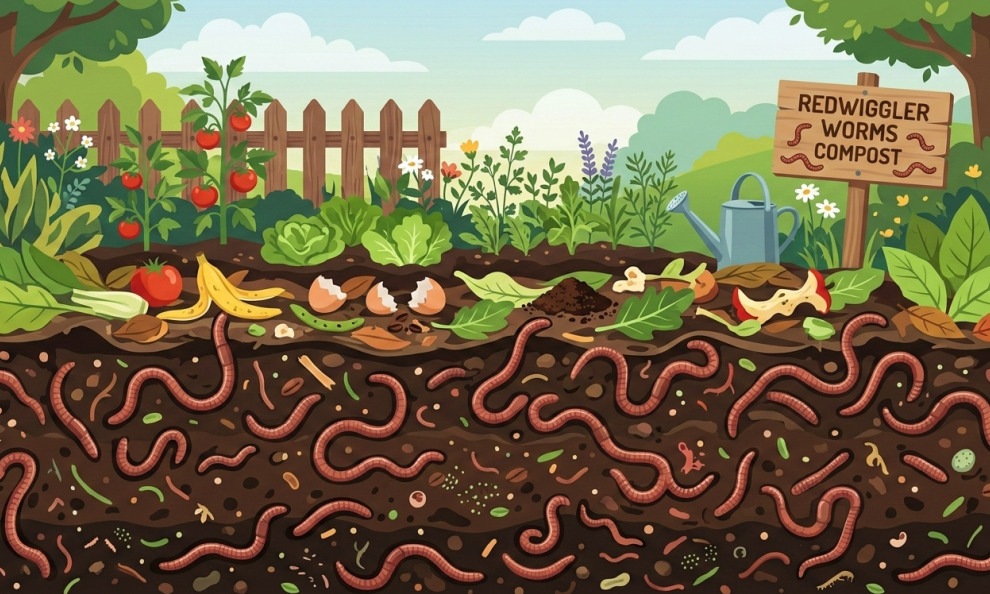
Exportearthworms.com – If you keep red wigglers (commonly Eisenia fetida, the little orange-red composting champions), one question always comes up: how fast do they reproduce, and can you reliably speed that up? Short answer: red wigglers are prolific under the right conditions most studies and experienced vermicomposters report 2–5 cocoons per adult per week, with each cocoon typically hatching 2–4 juveniles but the actual multiplication rate depends heavily on temperature, moisture, food quality, population density, and the worms’ age. Below I break down the hard numbers, the science behind them, and practical steps you can take to encourage faster, healthier reproduction.
What “reproduction rate” actually means for red wigglers
When people ask “How many babies does a worm have?” they usually mean population growth over time. For red wigglers you need to think in three linked metrics: (1) cocoons produced per adult per time (cocoons/week is the typical measure), (2) hatching success and hatchlings per cocoon (how many juveniles emerge), and (3) time to sexual maturity (how long until those juveniles can themselves reproduce). Multiply those together and you get realistic population growth projections. Lab and field studies show wide variation from about 2 cocoons/week on average in many experiments, up to 5–6 cocoons/week in ideal, intensely managed lab cultures. Each cocoon usually contains 2–4 viable hatchlings, with hatching success commonly 70–90% in healthy systems.
Typical numbers: how fast can they multiply?
Let’s translate those ranges into simple terms. If an adult lays 2 cocoons/week and each cocoon yields 3 juveniles on average (a conservative mid-point), that’s 6 new worms per adult per week but remember juveniles take several weeks to mature. Under extremely favorable lab conditions some authors report 3–4 cocoons per worm per week or higher; historic reports even cite up to 5–6 cocoons/week in very rich substrate. Conversely, in cold, dry, or nutrient-poor bins reproduction can drop to near zero. Practical vermicomposters commonly observe population doubling times measured in weeks to a few months, not days.
Timeline: cocoon incubation and time to maturity
Cocoons usually need 2–4 weeks to hatch under warm, favorable conditions; this increases in cooler temperatures. After hatching, juveniles take 4–10 weeks (commonly ~6–8 weeks) to reach sexual maturity and begin producing cocoons themselves again, temperature and food quality govern speed. In controlled life-cycle tests, researchers often use ~20–25°C for standardization because maturation and reproductive output are predictable in that band.
The limiting factors what really controls reproduction
Reproduction is ecological: it depends on the environment the worms live in. The major drivers are:
- Temperature. Red wigglers tolerate a wide range, but reproduction and hatch rates peak in the warm-but-not-hot window. Extension and lab work point to roughly 18–25°C (65–77°F) as the sweet spot for steady reproduction, with peak activity often noted closer to the low-to-mid-20s °C. Cooler bins slow or stop reproduction; very hot bins can cause stress and mortality.
- Moisture and humidity. Red wigglers breathe through their skin and need damp bedding (commonly recommended ~70–85% relative moisture in the material). Too dry = low activity and reproduction; too wet = anaerobic conditions, unpleasant odors, and stressed worms.
- Food quality and C:N balance. High-quality, partially decomposed organic matter (aged manure, well-rotten vegetable waste, properly processed bedding) encourages growth and cocoon production. Many experiments show strong links between substrate type and cocoon output. Extremely fresh, high-salt, oily, or meat wastes reduce reproduction.
- Population density and space. Overcrowded bins stress worms and reduce per-worm cocoon production. Commercial guides suggest surface-area-based stocking and rotating feed to avoid local crowding.
- Age and health of the breeding stock. Young adults just reaching maturity produce fewer cocoons than prime adults; elderly or heavily stressed adults can stop reproducing. Parasites, toxins, or contaminant exposure sharply reduce hatching success in scientific tests.
Can you boost reproduction? Yes – but here’s how to do it responsibly
If your goal is to grow your red wiggler colony faster, focus on optimizing conditions, not gimmicks. Here are evidence-backed steps that reliably increase reproductive output:
- Aim for the right temperature band. Keep your bin in a stable, warm area around 18–25°C (65–77°F) especially when trying to push reproduction. Avoid daily swings and extremes; insulation, indoor placement, or simple heat mats (used carefully) can help in cold climates.
- Maintain moist, airy bedding. Use shredded cardboard, coconut coir, or aged paper mixed with finished compost to give both moisture retention and aeration. Check by feel: the bedding should be like a wrung-out sponge. Too wet? Add dry bedding and improve drainage.
- Feed smart, not more. Provide a balanced diet: kitchen veg scraps, aged manure, and some grain or composted feedstocks give good results. Avoid raw meat, greasy food, and excessive citrus or onion. Break food into small pieces or pre-compost it a bit to reduce stress and ammonia spikes. Studies tie substrate quality directly to cocoon output.
- Control stocking density. If you want rapid breeding, use breeding bins with moderate starting densities so adults aren’t competing. Many commercial operations follow surface-area guidelines (for example, about 1/2 lb per sq ft as a starting reference) and harvest juveniles into new tubs as they mature.
- Keep pH and salts in range. Red wigglers tolerate a wide pH but prefer slightly acidic to neutral bedding (pH around 6–7); avoid salty or heavily fertilized kitchen wastes that leach salts.
- Use clean stock and rotate breeding populations. Healthy, contaminant-free parent worms produce better cocoons and higher hatching success. If your stock shows disease or low fertility, introduce fresh, vigorous breeders or split into fresh substrate. Lab tests repeatedly show reproduction collapses under toxic stressors
Note: “aphrodisiac” additives or secret recipes (often circulated in forums) rarely have robust scientific backing; focus on the basics above for reliable gains.
Mistakes that kill reproductive momentum
- Overfeeding and letting the bin go anaerobic (smelly, slimy) – that will quickly reduce egg laying and hatch rates.
- Letting the bin get cold for weeks (reproduction can pause).
- Using fresh chicken or pig manure without proper aging – it’s high in ammonia and can suppress reproduction.
- Crowding without giving space to settle or split the population.
Realistic expectations and scaling up
Even with perfect care, reproduction isn’t instantaneous: expect several weeks before juvenile cohorts mature and start contributing to exponential growth. If you need to scale quickly for commercial production, consider multiple stacked breeding trays, temperature control, and planned harvesting approaches used by commercial vermiculture operations and detailed in extension guidance and standardized test methods. For controlled experiments and reproducible metrics, researchers typically standardize temperature at around 20±2°C (as in the OECD earthworm reproduction test) to compare outputs.
(If you want, I can run a simple projection calculator for you: give me your starting number of adults, target population, and whether you’ll keep the bin in “average” or “optimal” conditions, and I’ll estimate a timeline.)
Closing – summary & practical checklist
Red wigglers reproduce quickly when you give them the right environment: 2–5 cocoons per adult per week is a useful working range; 2–4 hatchlings per cocoon is typical; 2–4 weeks to hatch and 4 -10 weeks to maturity are common timelines. To boost reproduction, control temperature, moisture, food quality, stocking density, and bedding prioritize stability over tricks. With steady care, you’ll see reliable population growth and a thriving vermicompost system.